
32 Interesting Facts about Galway
Top fun, weird & wonderful Galway facts you may not know 📖
- In 1477, Christopher Columbus visited Galway and this was noted in the margin of his copy of Imago Mundi. The people of his birthplace, Genoa in Italy, presented a memorial to the people of Galway in commemoration of this visit.
- St. Nicholas’ Collegiate Church (Church of Ireland) is the largest medieval parish church in Ireland still regularly used. Christopher Columbus almost certainly worshipped here in 1477.
- In 1473 Galway was almost destroyed by fire. However, this provided the impetus for its wealthy citizens to erect lavish houses e.g. Lynch’s Castle, and the city was rebuilt in a planned fashion.
- Lynch’s castle (the residence of one of the Mayors of Galway and now a bank) is the oldest building in Ireland in daily commercial use.
- The word ‘lynch’ is reputed to have its origins in Galway. The story goes that the son of a former mayor of Galway, James Lynch Fitzstephen killed a Spaniard (in medieval times Galway had strong trading links with Spain) over a woman. As Chief magistrate the mayor felt it incumbent on him to impose the law even though the defendant was his own son. When nobody could be found to carry out the sentence Fitzstephen is supposed to have executed his son himself. No reference in the town records can be found for this story and it is more than likely false. Incidentally, the real source of the word is thought to be Captain William Lynch of Virginia, USA who in 1782 was indemnified for illegally punishing people.
- In medieval times Galway was ruled by 14 merchant families. These ‘tribes’ are where Galway gets the nickname the ‘City of the Tribes’ or ‘Cathair na dTreabh’ and include names such as Athy, Blake, Bodkin, Browne, D’Arcy, Deane, Ffont, Ffrench, Joyce, Kirwan, Lynch, Martyn, Morriss and Skerrett.
- After the English Civil War(s) the British parliament at the behest of Oliver Cromwell ordered the execution of the defeated Charles 1. So that he would not be executed by an Englishman, volunteers were looked for in Scotland and Ireland. Two Galway soldiers Gunning and Dear offered their services and were sent to England. On 30 January 1649, Gunning was chosen to perform the execution. As a reward, the property where the pub The King’s Head now stands was bestowed on him.
- Bubonic plague was introduced into the city by a Spanish ship in 1649 and killed at least 3,700 of its inhabitants and forced many Galway residents to abandon the city temporarily.
- St. Nicolas of Myra has been the patron saint of Galway city since the 14th century. He lived in Greece in the 4th century. This choice of patron is common among sea-ports because he is the patron saint of sailors and merchants. He is also considered to be the patron saint of children and is thought to be the inspiration for the modern day Santa Claus.
- Tigh Neachtain public house, at the junction of Cross and High Street, was the townhouse of Richard Martin (also known as ‘Humanity Dick’) who, as one of Galway’s first Members of Parliament at Westminster, was instrumental in bringing new anti-cruelty laws which led directly to the founding of the Royal Society for the Prevention of Cruelty to Animals (RSPCA). On his actress wife’s insistence, he also established a small theatre in Kirwin’s lane (adjacent to Busker Browne’s pub) where the insurrectionist Theobald Wolfe Tone trod the boards. Tone was rumoured to have been infatuated with Martin’s wife.
- The cannons on display in Eyre Square were captured from the Russians during the Crimean War (1853-56) by the British Army who subsequently presented them to the town of Galway. During the ‘Fenian fever’ of the 1860s they were removed in case the Fenians (a militant separatist organisation) used them as weapons against the government.
- Galway was one of the counties most affected by the Great Famine (1845-47); approximately 20% of the population died. Relief works carried out during the Famine included the construction of the Dyke Road and Threadneedle Road. This still bears the Irish name, Bothar na Mine, The Meal Road, today.
- Queens College Galway opened in 1849 with only 68 students. About 20,000 students now attend the National University of Ireland, Galway.
- The (Roman Catholic) Cathedral of Our Lady Assumed into Heaven is built on the site of the old Galway gaol.
- Irish sporting ballad ‘The Fields of Athenry’ is a folk ballad set during the Great Irish Famine and tells the story of Michael from Athenry, Co. Galway who is sent to penal colony, Australia, for stealing food to save is starving family. Written by Pete St. John in the 1970s, it is widely sung at Irish rugby and soccer internationals.
- The longest place name in Ireland is Muckanaghederdauhaulia, a townland found in County Galway. The Irish version of the name, ‘muiceanach idir dhá sháile’, means “piggery between two briny places” and probably refers to a pig farm once located in the area.
- The famous actor, Peter O’Toole, has a strong connection with Galway. He claimed that he was born in Galway before being taken to England as a baby. He built a house outside Clifden in the county in the early 19705, where he spent many holidays and lived there at various times. The star of films like Lawrence of Arabia, The Lion in Winter and Venus, he won many awards but holds the record for the most Academy Award (Oscar) nominations without a win. He was awarded an Honorary Academy Award in 2003. O’Toole passed away in 2013 and his ashes were scattered in Connemara.
- Maria Edgeworth, author of Castle Rackrent, considered Galway the dreariest town she had ever been in.
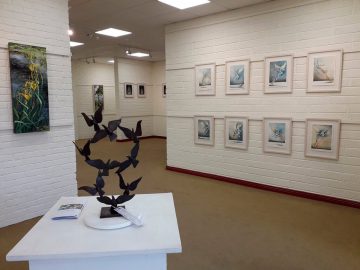
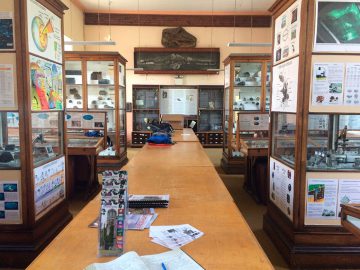
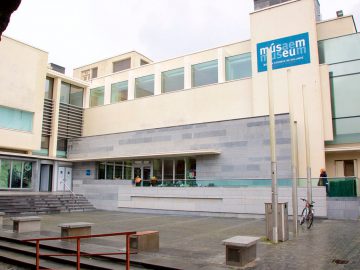
- There are 35 heritage sites, 31 museums and 10 art galleries in Galway City and County.
- The River Corrib is the second-fastest flowing river in all of Europe, moving at a staggering 9.8 feet (3 meters) every second. It runs for 6 kilometers (3.7 miles) from Lough Corrib via Galway to Galway Bay. The fastest flowing river is also on the island of Ireland – the River Foyle in Derry.
- Galway has 689 kilometers of coastline, all of which is part of Ireland’s Wild Atlantic Way.
- Galway is famous for being the festival capital of Ireland, hosting on average 122 festivals and events per year.
- Although Galway is often cited as being the fastest growing urban area in Europe, it was relatively slow to develop. During the early medieval period it was not even considered a town; Athenry was 2.5 times its size. Galway began to prosper in the fifteenth century and it evolved into an important seaport. Wine was one of its major imports and it was the importation and distribution of this commodity which helped to found its commercial prestige.
- Connemara marble, which is also known as Connemara Green, is estimated to be 500 million years old. Quarried at the Streamstown Marble Quarries near Clifden, it has been used over the years as a means of exchange as well as in stately buildings.
- The Claddagh Ring was first created in Galway during the 17th-century and has been worn by no less than Jim Morrison, John F Kennedy, Jennifer Aniston, Julia Roberts, Kim Kardashian and Walt Disney to name but a few. It remains a timeless symbol of love, loyalty, and friendship.
- There are three breeds of horses indigenous to Ireland. These are the Connemara pony, the Irish draft and the Irish hunter. Each one of these breeds is noted for its surefootedness, intelligence and grace under pressure.
- Galway has the largest Gaeltacht (Irish speaking community) in Ireland. The other Gaeltacht areas cover extensive parts of counties Donegal, Mayo and Kerry and also parts of counties Cork, Meath and Waterford.
- The Merriman Hotel in Kinvara, Co. Galway has the biggest thatched roof in Ireland.
- The village of Carraroe in Galway is home to world-renowned Harriet, The Singing Donkey.
- Almost a quarter of Ireland’s lake area is in County Galway. 23 percent, or 28,498 hectares, of Ireland’s lake area is in the county. Neighbouring Mayo is a close second with almost 18% or just over 22,000 hectares.
- Galway has been voted Europe’s friendliest city in the Condé Nast Traveller Reader Travel Awards on multiple occasions, most recently in 2020, with Dublin coming in second place.
- Galway is the birthplace of Nora Barnacle’s, wife of James Joyce, one of the most influential and important writers of the 20th century. Nora Barnacle’s House at Bowling Green is believed to be Ireland’s Smallest Museum.
Best Rate Hotels
Powered by